Design Thinking

Data Science Student & FullStack Web Developer
Leverage Design Thinking to pivot an existing project, or start something new
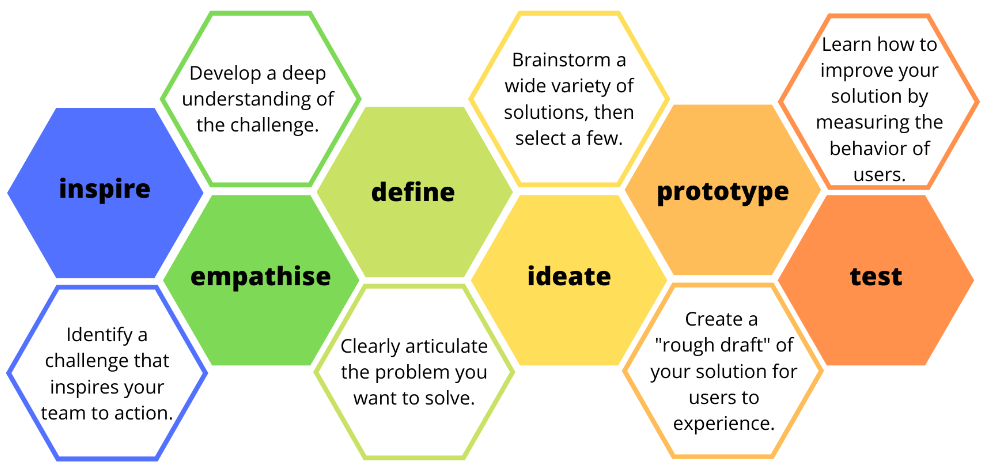
Design Thinking?
Design Thinking is a method for solving complex problems. It is a wel established technique to design solutions that create lasting impact.
As a team, integrating Design Thinking into your process will help you increase the success and impact of your projects while creating a more engaging learning environment.
As an individual, regardless of which direction your career leads you, a foundational understanding with real-world application of Design Thinking will give you a solid edge.
Modes of Design Thinking
Inspire
Is the process of motivating your team into action. It's a mix of motivation and direction setting.
info
Keep in mind, you don't need to have a detailed understanding of your final destination to get started BUT you do need a direction.
Having a general, even vague, sense of direction will give your members the minimum amount of structure needed to take those first steps forward.
tip
- Spend time discussing within your team the challenges and problems you're inspired and called to work on.
- Narrow down to the top 1-2 issues your team wants to further explore.
- In case you have already chosen a project and people are losing inspiration, Spend time reconnecting with and sharing your WHY so that members can reignite and share their passion and purpose.
Empathize
To create meaningful innovations, you need to know your users and care about their lives.
It is not only about understanding the problems and needs of the people, BUT more importantly, it is about caring enough and being committed enough to actually solving a problem.
caution
Empathy is the most important mode for breaking out of your own personal baises and misunderstandings TO truly connect with the problems and challenges of the people you're serving.
tip
- Spend time with your team discussing and framing the problem. Start making connections on your compus and your community with the goal of speaking with people who are directly impacted and with stakeholders who work directly on the challenge.
- Create contacts with potentail paterns, customers or beneficiaries.
Define
Framing the right problem is the only way to create the right solution
caution
To create a solution, you must first clearly define the problem.
tip
Develop a Point-of-View(POV), like this template:
"User ...(descriptive)", "Need ...(verb)", "Insight ...(compelling)". For exp:Sara, a single mother of 3, needs access to childcare that offers a wider range of hours. She often gets called into working very early hours and most childcare centers are not able to accept kids before 6 am.Work through the Problem Tree, to have a 360-degree understanding of your problem.
For more about Problem Tree
Problem Tree, by ENACTUS:
Ideate
It's not about coming up with the right idea, it's about generating the broadest range of possiblities.
Now that you have a general idea of the people and the problem you are solving for, it's time to brainstorm to generate as many different postential solutions as possible.
Quantity is what's most important here, not only the quantity of ideas, BUT also the quantity of people who share their ideas.
tip
- Brainstorm a wide variety of ideas, choosing your brainstorming method of choice.
- Voting criteria for your ideas. exp:
- Most likely delight
- Rational choice
- Most unexpected It is up to you.
- Carry the 2 or 3 ideas that receive the most votes foward into prototyping.
Prototype
Build to think and Test to learn.
Now that you've narrowed down to a 2 or 3 potential solutions, its time to start prototyping.
A prototype is essentially a rough draft version of your solution that allows people to actually experience your idea (either partially or wholly).
note
A prototype doesn't need to be a physical product. It can be a flier, a website, a presentation, or a Facebook page.
tip
- Start brainstorming ways that you can prototype your product or service.
- Speed, your goal is to create a prototype as rapidly as possible so you can begin testing quickly.
Test
Testing is an opportunity to learn about your solution and your user.
This mode is where you solicit feedback and learn about how your user experiences your product or service.
note
A rule of thumb: always prototype as if you know you’re right, BUT test as if you know you’re wrong—testing is the chance to refine your solutions and make them better.
tip
While testing, ask yourself:
- Do they know how to use it?
- Are they annoyed by something?
- Did they learn what they were intended to?
- Do they love X and dislike Y?